

Want a backyard that feels tucked away without looking boxy? These ideas move past fences and focus on how layout, planting, and structure work to control what is visible and what disappears.

In 2026, privacy comes from placement, not height. Layers overlap, lines of sight are redirected, and attention remains within space. Rather than blocking the yard, these setups reshape it so it feels enclosed, quiet, and completely yours without adding heavy boundaries.
What stands out is how subtle the changes are. A change in level, a dense planting line, or a well-placed structure can do more than a tall fence ever will. The result is a space that feels safe when you enter it, without looking closed in from the outside.
Boulder seating that creates a natural edge

Large stones create a low perimeter that defines the seating zone without adding walls. A circular layout draws the focus inward, while planting behind it creates a soft visual barrier.
This approach works because it blends structure with landscape. The stones act as seating and boundary at the same time, reducing the need for additional screening elements.
A raised green wall that blocks sight lines from above

A dense vertical lawn edge creates a strong visual wall that blocks views from high angles. Clean cuts and height shifts make it effective without the need for fencing.
The contrast between the grass and the dark edge sharpens the boundary. It reads as a landscape, not a structure, that keeps the space open while being protected.
Dense layered plantings that eliminate depth visibility

Thick planting with mixed heights closes the gaps between elements. Ferns, shrubs and medium height plants overlap to eliminate clear sight lines.
This works by reducing visibility through the space rather than directly blocking it. The eye cannot travel far, which creates a sense of closure.
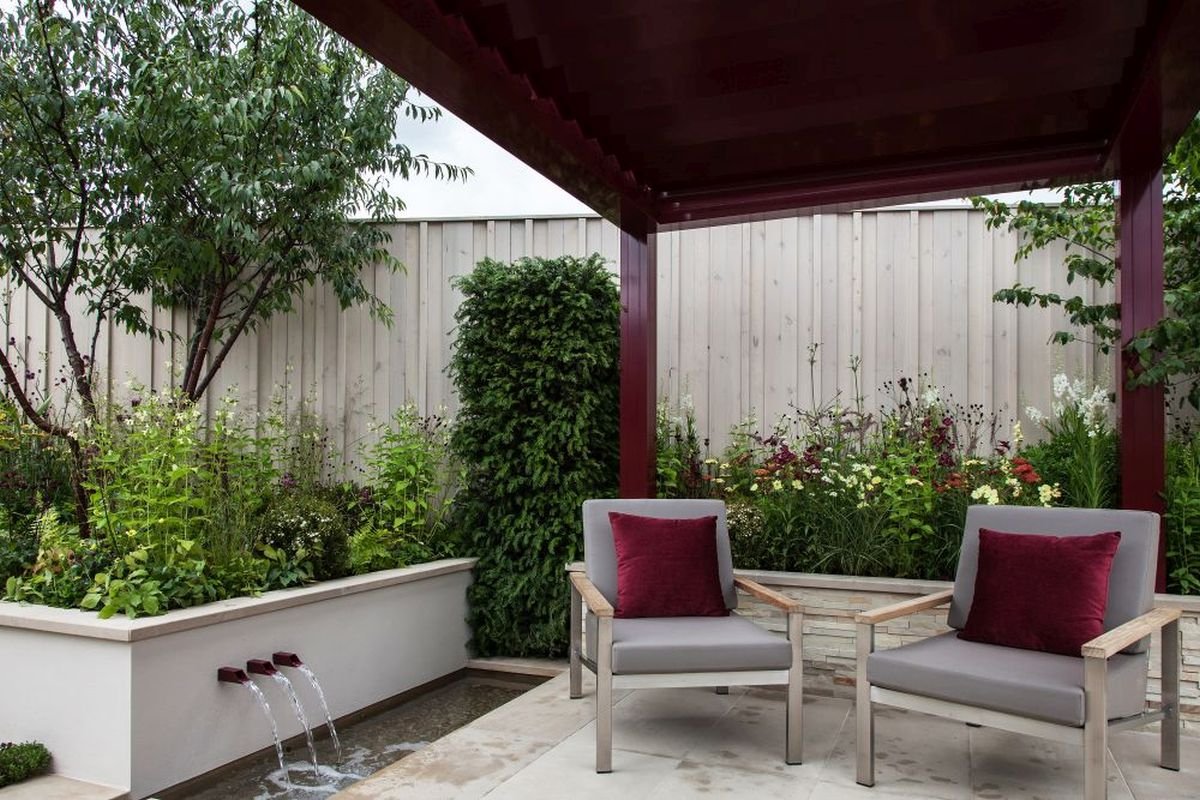
A pergola frame that defines a private zone

A simple frame with a light fabric overhead marks a clear area for seating. The structure shapes the space without completely closing it off.
Surrounding plantings and screens complete the effect. Together, they create a room-like feel that separates this zone from the rest of the yard.
Slatted wall with integrated plant display

A horizontal slatted wall filters views while still allowing light to pass through. Mounted planters break up the surface and add depth.
This combination draws attention to detail rather than what lies ahead. The wall acts as both a backdrop and a screen.
A vertical green screen that covers an entire wall

Climbing plants fill the structured grid, turning a flat wall into a living surface. Density blocks visibility by keeping soft edges.
Repeated patterns create rhythm across the wall. Over time, growth thickens the screen and improves coverage.
A raised planter that forms a mid-level barrier

A tall planter runs along the edge, bringing the greenery up to eye level. This blocks views without the need for tall structures.
Mixed plantings inside add variation in height and texture. The result looks layered rather than flat.
Metal and glass edges that separate without closure

Corten steel and glass panels define boundaries without blocking light. The material creates contrast while guiding the movement.
Planting behind the panels adds depth and softens the line. This space is open but controlled.
A stone enclosure that wraps around the seating area

Stacked stone forms a partial enclosure around the circular seating zone. The height is sufficient to create separation without isolating the space.
Integrated planting softens the structure around the edges. The result feels grounded and secure.
A tiered planter that builds height gradually

Tiered planters go uphill, adding height without a single vertical wall. Each level increases the planting density.
This approach spreads the screening effect throughout the depth. It avoids a hard barrier while limiting visibility.
A garden room framed by a central structure

A centrally defined structure draws attention inward and creates a contained zone. The surrounding planting creates a natural wall around it.
The contrast between the open entrance and the dense perimeter reinforces the effect. It looks like a separate room in the garden.
Sunken lounge with surrounding planting

Reducing the seating area changes perspective and reduces contact. Surrounding plants appear taller, adding to the sense of privacy.
This change in level creates separation without adding height. The space feels closed while the top is open.
Curved wall with integrated planting

A curved brick wall guides movement and blocks direct views. Planting along the top softens the edges and adds height.
Curves prevent long sight lines. It draws attention to the space rather than to it.
Patio zone defined by low hedging

Low hedges outline the seating area and create a subtle boundary. They separate the zones without closing them.
Complete surrounding trees and plantings. Together, they create a layered effect that keeps the space private without heavy structures.
A compact seating corner wrapped in dense greenery

Two chairs placed in a tight gravel zone create an obvious seating area, but the real impact comes from the planting behind. Tall bushes and large leafy foliage close off the space on all sides, eliminating any view beyond the immediate area.
This setup works by compressing the layout and surrounding it with density. The seating appears tucked rather than open, while the layered greenery acts as a perfect natural screen without adding fences or built structures.



