
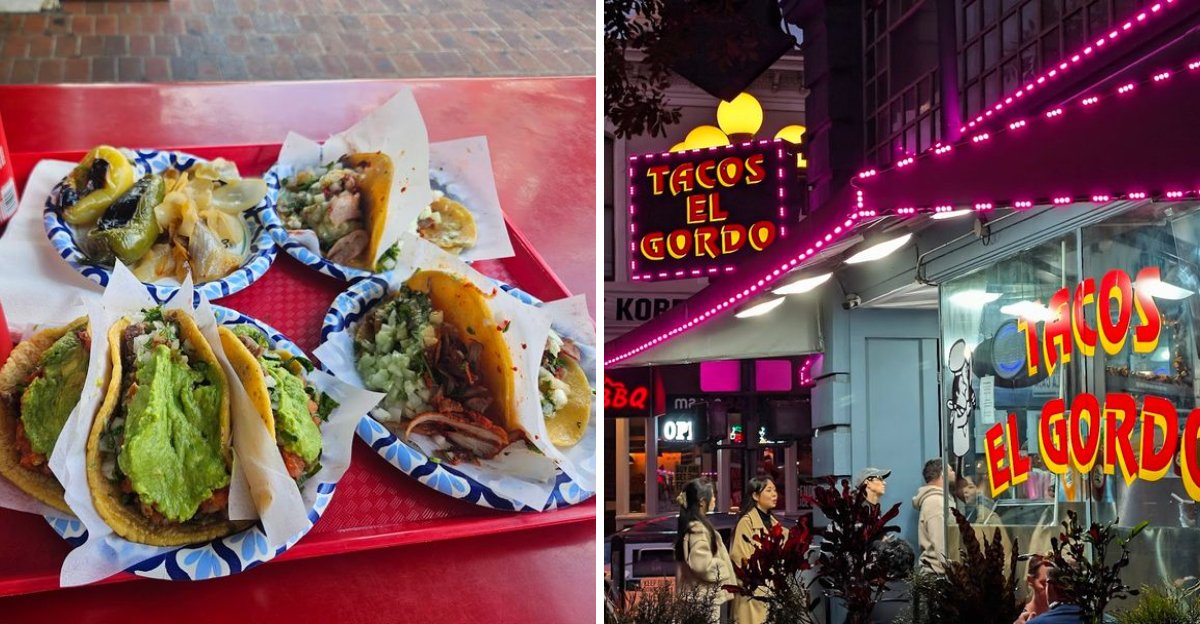

Taco cravings get more serious when the salsa starts showing up. A California taco counter lets salsa steal the spotlight in the best possible way.
Each spoonful brings a bright, punchy kind of energy that changes the entire rhythm of the meal, making each bite sharp, lively and a little harder to forget.
Of course, the tacos are the main deal, but with salsa like this they start to feel like the setup for what makes a place truly memorable.
It makes stops like this so much fun.
You arrive expecting a solid plate of tacos, then end up talking about the salsa with an excitement usually saved for the main dish.
A taco counter built on Tijuana roots
Before the downtown San Diego location became a late-night landmark, Tacos El Gordo’s story began across the border in Tijuana.
The family-owned operation opened in 1972, and those Baja roots aren’t just a backstory – they shape everything from the tortilla recipe to the way the meat is seasoned and cooked.
Arriving in San Diego in 1998, the taqueria brought with it a style of taco making that felt truly different from what most people in the city had seen.
Handmade corn tortillas are pressed fresh and cooked to order, giving each taco a texture that can’t be matched by store-bought shells.
The cross-border tradition behind this place runs deep, and that history shows in every bite.
Tijuana-style taquerias are known for their no-frills setup, bold meats, and finishing-touch culture where salsa, radishes, and limes are considered essential rather than optional.
That philosophy transferred directly to the San Diego counter.
A counter-serve setup that sets the tone
Walking up to the counter at Tacos El Gordo for the first time feels like stepping into a well-rehearsed performance.
There are different stations for different meats, and each is staffed and run independently, which means the ordering process is more deliberate than it first appears.
Customers line up at the station that matches their meat preference – adobada, carne asada, suadero and others each have their own dedicated spot.
This setup keeps things moving quickly while also ensuring that each meat gets the exact attention it needs. The result is a fresher, more focused product than a single all-in-one counter.
For anyone used to pointing and waiting at a menu board, this format takes some time to read. Once the rhythm clicks, though, it feels natural and even satisfying.
The counter-service model here isn’t just a logistical choice – it reflects the taqueria culture brought from Tijuana by Tacos El Gordo, where each taco station is its own little operation that works in harmony with the rest of the kitchen.
Lines, volume and rhythm of high-turnover counters
Expect a line. That’s not a warning—it’s part of the context for understanding what kind of place Tacos El Gordo is.
The downtown location runs at high volume, and lines outside or inside the counter are a consistent feature, especially during weekends and late-night hours.
A multi-station ordering setup helps manage that volume efficiently. Because each type of meat has its own dedicated station, the line for adobada moves independently of the line for carne asada or suadero.
That separation keeps items from clogging and allows the kitchen to maintain quality even when demand is high. Knowing which station to go to before stepping up saves time and reduces confusion.
The pace here rewards a certain kind of preparation. Having the order in mind before reaching the counter makes interaction easier and the line moves for everyone.
The staff work quickly and with clear focus, and the overall rhythm of the place has a rhythm that feels satisfying once it clicks.
High turnover at the taco counter isn’t a sign of carelessness—at Tacos El Gordo, it reflects a system that’s been refined over decades of feeding serious crowds with consistent results.
Adobada – the meat that keeps coming
Ask around what to order at Tacos El Gordo and the answer almost always revolves around adobada.
The spicy pork is marinated in a mixture of dried chilies and spices that give it a deep red color and a layered heat that builds slowly with each bite.
It’s the kind of meat that holds up well under bold toppings without getting lost.
The adobada at this counter is cooked on a vertical spit in traditional trompo style, allowing the outer layers to crisp while the interior remains juicy.
That contrast in texture is a big part of what makes it so satisfying.
Tucked into freshly cut and warm handmade tortillas to order, they arrive at the counter ready with sauces and garnishes to match.
The brand itself highlights the spicy adobada as a signature, and the constant attention it receives from diners shows how central it is to the menu.
Even for someone who usually gravitates toward carne asada or another option, it’s worth trying adobada at least once.
The full meat menu and what makes each option worth knowing
In addition to adobada, Tacos El Gordo’s menu covers an array of meats that reflect traditional Tijuana taqueria cooking.
Carne Asada brings grilled beef with char and saltiness that pairs cleanly with fresh salsa.
Suadero, which is a slow-cooked beef brisket cut, offers a softer texture and higher fat content that melts easily into the tortilla.
Cabeza and lengua round out the more adventurous end of the menu.
Cabeza, made from braised beef head, has a tender and slightly gelatinous quality that regulars appreciate for its depth of flavor.
Lengua, or beef tongue, is another slow-cooked option that surprises many first-timers with how tender and silky it becomes once properly prepared.
Having this range available at a counter-service spot is part of what makes Tacos El Gordo feel more like a serious taqueria than a fast-food operation.
Each meat is handled with its own cooking method and timing, and that care shows in the prepared tacos.
Trying a few different options in one visit is a reasonable approach and a good way to get a full sense of what the menu can do.
The Salsa Bar is where the whole show really happens
The salsa situation at Tacos El Gordo isn’t a condiment table—it’s an end station, and it plays a central role in how the tacos actually taste.
The salsa is made fresh daily, which means the flavor is brighter and more layered than anything that comes out of a jar.
The difference between freshly made salsa and shelf-stable is noticeable from the first bite.
A variety of salsa options are available in heat levels and bases.
Some are tomatillo-forward and tangy, others are chili-heavy and smoky, and the range allows for real customization based on meat and personal preference.
Pairing the right salsa with the right taco is part of the ritual that regular customers develop over time.
Fresh radishes and lime wedges sit alongside the salsa, and are treated as real ingredients rather than garnishes.
A squeeze of lime brightens the whole taco, and a slice of radish cuts the richness of fatty meats like suadero or cabeza.
The finishing-touch culture at this counter mirrors what a traditional Tijuana taqueria setup looks like, where the end build is as important as what goes inside the tortilla.
Fresh radishes and limes on the garnish side of the counter
Not every taco spot thinks carefully about what sits next to the salsa, but the garnish side of the counter at Tacos El Gordo is part of a deliberate setup steeped in Tijuana’s taqueria tradition.
Fresh radishes and lime wedges are always present, and for a reason that goes beyond visual appeal.
Lime juice definitely does something to a taco that no sauce can quite replicate.
The acidity cuts through the fat, awakens the seasoned meat, and balances the heat from the spicy salsa that feels clean rather than diluted.
A quick squeeze before the first bite changes the entire profile of the taco, and skipping it is a missed opportunity.
Radishes bring crunch and a mild peppery bite that contrasts with softer, slow-cooked meats like cabeza or lengua.
The texture difference alone makes the eating experience more dynamic. Together, radishes and limes represent an ultimate philosophy that treats tacos as something to be accomplished rather than already handed out at the counter.
That little detail reflects Taco’s deep commitment to craftsmanship, and it’s one of the things that makes eating here feel truly different from a standard fast-casual setup.
More than tacos with soups, quesadillas and meat fries
Tacos are the main event at Tacos El Gordo, but the menu extends beyond what most people realize on a first visit.
Soups, quesadillas and meat fries are part of the items available at the counter and each has the same quality ingredients that make tacos worth talking about.
Sopes are thick corn masa rounds topped with meat, beans, and fresh garnishes, and they offer a heartier alternative to the taco format without straying far from the same flavor profile.
The masa base gives them a chewier texture than tortillas, and the toppings can be customized with the same salsas and garnishes available at the main counter.
Meat Fries brings a more unexpected option to the menu – seasoned fries filled with the same meat used in tacos, turning a familiar format into something with a distinctive Baja flavor.
Quesadillas follow the traditional format here, with melted cheese and meat fillings, rather than the oversized flour-tortilla versions common in many American Mexican restaurants.
Trying one of these options alongside a taco order is a reasonable way to get a full picture of what the kitchen can do outside of the main taco lineup.
Downtown San Diego location and hours
It’s not always easy to find a great taco spot that’s open after midnight, but the downtown San Diego location makes it easy.
Tacos El Gordo is located at 511 F St, San Diego, CA 92102, United States, in the middle of a busy area that sees a good amount of foot traffic in the early morning hours.
The hours here are really useful for night owls and the after-dinner crowd. From Sunday to Thursday, the counter is open from 10 am to 2 am and on Friday and Saturday it is open until 4 am.
This kind of schedule makes this place a reliable anchor for anyone feeling hungry late in the Gaslamp Quarter area.
Proximity to downtown entertainment and dining puts this location in a high-traffic zone where lines can move quickly but are still long.
Arriving during off-peak hours on a weekday afternoon offers a quieter experience for first-timers looking to take their time at the counter.
That said, Busy Line also moves at a steady clip, which is part of what gives the whole place its lively, efficient taco-counter rhythm.



