
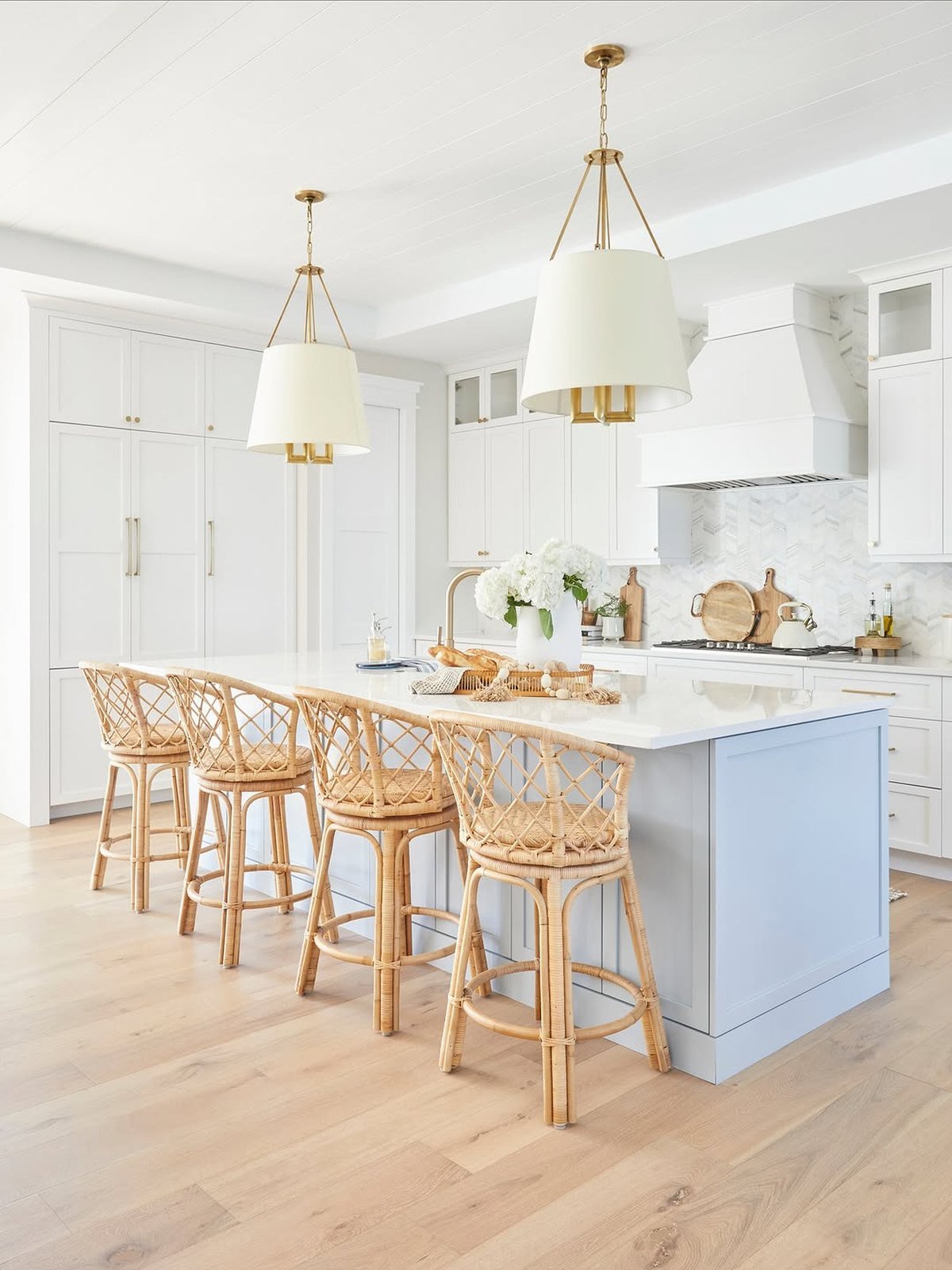

Want a kitchen that looks bright but yet you can actually see? This coastal layout shows how blue and white cabinets work together to define the space instead of blending everything into one flat tone.

In 2026, the all-white kitchen is being adapted, not replaced. White still keeps the room open, but blue cabinets are now used to anchor islands, frame storage walls, and create clear zones throughout the layout. The contrast is subtle, but it changes how the kitchen reads from every angle.
From soft pastel bases to deep navy accents, these ideas show how blue and white cabinetry creates depth, guides movement, and makes a simple layout feel complete without adding extra elements.
Waterfall marble island with warm wood seating contrast

The island becomes the main visual anchor through full height marble with visible veining. Instead of keeping everything white, the stool introduces warm wood and soft upholstery, breaking up the surface without being cluttered.
This setup works because it balances the two directions. Stone keeps the space clean, while wood tones prevent it from feeling cold. The result is a kitchen that reads finished without relying on decoration.
Woven pendant lighting that softens the large island

Large woven pendants draw attention to the texture overhead from the hard finish. They measure the island correctly while diffusing light, which avoids harsh reflections on the countertop.
Paired with woven stools, the lighting creates continuity throughout the space. Instead of separate elements, everything is connected to a single content story that feels relaxed but still structured.
Mute blue island base with natural stool framing

A soft blue island base introduces color without overpowering the room. It defines the island as its own zone, staying within a calm palette.
Woven stools add texture and keep the blue from looking too polished. Together, they create a layered look where color and material support each other rather than compete.
Light wood island panels that replace painted bases

Instead of a painted island, vertical wood paneling brings subtle variation across the surface. It adds rhythm without the need for contrasting lines or bold colors.
Woven bar stools reinforce that direction. The space feels warmer and more grounded, while maintaining the brightness expected of a coastal kitchen.
Patterned seating that breaks up a neutral kitchen

Black and white woven stools present a restrained pattern. They become the main visual detail without changing the rest of the kitchen.
This approach keeps cabinetry and surfaces simple while still adding depth. The pattern acts as a focal point, avoiding the need for additional decorative layers.
Soft blue tile backsplash with natural wood accents

A backsplash represents color through texture rather than paint. The geometric tile reflects light differently across the surface, creating movement without visual noise.
Wood accents around the hood and shelves keep the palette balanced. The space looks designed, not just colorful, which is key in updated coastal interiors.
Pale blue cabinetry with integrated wood framing

Muted blue cabinetry replaces plain white, staying in a soft coastal palette. The tone adds depth without making the kitchen feel small.
Wood framing and accents around the hood tie the cabinetry to the rest of the room. This prevents the color from feeling isolated and keeps the layout consistent.
A compact island setup that still defines the seating zone

Even in small layouts, the island creates a clear seating and prep zone. The overhang and stool placement make it functional without expanding the footprint.
A combination of light cabinetry and subtle wood tones keep the space open. It shows that coastal design works through proportion, not just size.
Deep navy island with rope-frame seating details

The island shifts from light neutrals to a deep navy base that anchors the entire kitchen. Brass hardware and warm metal pendants add contrast, preventing darker tones from feeling overwhelming.
The stool features a rope-wrapped frame that ties directly into the coastal theme. This detail turns seating into a design feature, not just a functional add-on, while strengthening the connection to the outside view.
A soft white kitchen with subtle patterns by the seating

The space remains mostly white, but pattern seeps in from woven stool seats and a striped Roman shade. Instead of adding color, design creates variety through texture and repetition.
This approach keeps the kitchen bright by avoiding flat surfaces. Small details carry visual weight, giving a layout a finished feel without adding extra layers.
Blue base cabinets that define the narrow galley layout

The galley layout uses soft blue lower cabinets to establish structure on both sides. The color is continuous, making the narrow space feel intentional rather than cramped.
Open shelves and light countertops balance the cabinet depth. The result is a kitchen that feels layered but still open, with each surface contributing to the overall flow.
Symmetrical window wall with central island focus

A full wall of windows creates a strong backdrop that defines the entire layout. The island sits in the center, symmetrically aligned and acts as the main working area.
The light blue island base presents a contrast against the white cabinetry. This prevents the composition from blending together while maintaining a calm, coastal palette.
A wood ceiling and woven pendants add texture overhead

The ceiling changes from flat white to natural wood planks, adding warmth to the entire room. Woven pendants repeat that structure at lower levels, tying the ceiling and island together.
The base of the blue island grounds the space while the upper elements keep it light. This layered approach avoids relying on walls alone to carry the design.
Coastal mural wall with sculptural lighting as focal point

The wall becomes a feature through a large-scale marine mural that introduces movement and pattern. Instead of small accents, the design uses one dominant element to define the space.
On the island, sculptural lighting adds another layer of detail without cluttering the surfaces. The combination creates a kitchen that feels stylish by composition, not decoration.
A curved light blue island softens the kitchen layout

The island presents curved edges instead of a sharp rectangular form, which changes how the kitchen flows. It creates a smooth transition between prep space and seating, making the layout feel more open and easy to move around.
A light blue base paired with white cabinetry and a matching aqua backsplash keeps the palette consistent without mixing everything together. This setup shows how a subtle color shift at island level can define an entire room without overpowering it.
Soft blue cabinet frame with built-in panel details

The cabinetry uses soft blue tones in the tall units, island and hood details, creating a continuous frame around the space. Instead of isolating the color to one element, it spreads evenly, which makes the layout feel structured.
White walls and backsplash keep the room open, while dark wood floors anchor everything below. Contrast between base and upper tones defines zones without breaking the visual flow.
Light blue island with oversized pendant contrast

The island features a muted blue base that stands out against the stark white cabinetry. Large pendants of fabric-shades above create a strong vertical element that balances the horizontal spread of the island.
Woven stools add texture to the seating level, tying into the coastal theme without adding new colors. The result is a clean layout where contrast comes from scale and content, not complexity.
Beadboard blue island with structural bracket detail

The island uses beadboard panels and visible brackets to bring depth to the cabinetry. This detail transforms the island from a flat block into something that reads as built and crafted.
The surrounding white cabinets and multi-tone backsplash remain light, allowing the island to carry the visual weight. Plain wooden stools focus on structure rather than decoration.
Marble island with blue base and patterned seating

The marble countertop becomes a focal point, extending to the blue plinth in the center of the kitchen. The veining adds movement without the need for extra material.
A striped upholstered stool presents a pattern at seating level. This keeps the palette within blue and white while adding variation through fabric rather than additional finishes.
A dark blue cabinet wall that defines the back zone

A full wall of dark blue cabinetry creates a clear separation between the prep and storage zones. Deeper tones add weight and give the kitchen a more defined layout compared to lighter schemes.
Glass pendants and light countertops keep the space from feeling closed. The combination of dark cabinetry and an open dining area shows how contrast can organize a room without adding walls.



