

String lights had their moment. They fill a space quickly, add glow and work for almost any setup. But in 2026, outdoor lighting is moving away from overhead decoration and closer to the ground, where it can shape a space rather than just sit above it.

What emerges now is how light defines edges, paths and planting zones. Instead of hanging lines, you see integrated lighting that follows the material, highlights texture and guides movement in the yard. The result feels quieter, more architectural, and more deliberate from every angle.
Sunken seating corner with layered warm lighting

This setup shows how lighting can create a complete ambiance without an overhead source. Soft uplighting at the base of the trees, with hidden fixtures along the stone wall and seating zone, creates depth from many directions. Even without a roof or pergola the space reads as enclosed and quiet.
The water feature adds a reflective layer, catching the light and spreading it across the surface. Instead of brightness, the focus here is on contrast and shadow, where planting, stone and water each choose a different tone. It turns a small corner into a destination instead of just a pass-through.
Raised planters with integrated LED edging

Here, lighting is built directly into the structure. LED strips under the stone caps define the edge of each planter, making the layout visible even in low light. It keeps the space usable at night without the need for floodlights or overhead fixtures.
This approach also isolates zones. Patios, lawns and planting beds each have their own borders, so the yard looks tidy after dark. It’s a practical move that doubles as a design feature, especially in modern layouts with clean lines.
Level planting with concentrated uplighting

Instead of lighting everything, this design focuses on specific elements. A tree and a few key plants are lit from below, creating vertical emphasis against the fence. The rest of the garden remains dark, making the illuminated areas stand out.
This selective lighting prevents the space from feeling flat. It draws attention to height, texture and structure, especially when paired with layered plantings. The result looks more like a designed structure than a fully lit yard.
Path lighting that guides movement without glare

Low-path lights placed close to the ground create a clear path to walk without overwhelming the space. The light diffuses softly through the green grass and stone, making the path visible while keeping the surroundings calm.
This type of lighting works because it follows the layout. It does not compete with plantings or hardscape elements. Instead, it supports them, making the garden easier to navigate at night while keeping the overall look under control.
Garden beds with layered spot lighting

Multiple light sources are used here, but each is subtle. Small fixtures highlight individual plants and trees, creating a layered effect throughout the bed. The fence becomes a backdrop, catching some light and adding depth.
This approach turns the garden into a nighttime amenity. Instead of disappearing after sunset, the planting becomes more defined. It also avoids the flat look coming from a single light source.
Stepping stone path with integrated edge glow

The path becomes the main lighting element in this layout. Light is placed along the edges, guiding movement while also reflecting the shape of the space. It works particularly well with stepping stones and gravel, where contrast is important.
This type of lighting looks clean and modern. It eliminates the need for visible fixtures and takes care of the material. The result is a path that reads clearly both day and night.
Gravel courtyard with tree uplighting

Lighting at the base of the tree creates a strong vertical effect, especially in minimal gravel layouts. The ground remains neutral while the trees are the main visual focus. It gives height to the space without adding structures.
This setup also keeps the yard open. There are no hanging elements or bulky fixtures, so the space feels larger. Lighting defines the perimeter and highlights key features without clutter.
Step lighting that defines transitions

Built-in lighting adds both safety and structure along steps and level changes. Each step is clearly visible, and the transition between layers feels deliberate. It also adds a layered effect, where the light moves with the layout.
This type of lighting works well in multi-level yards. It avoids harsh overhead lights and instead follows the natural movement of the space. The result looks more integrated and easier to use at night.
Curved lawn edge with continuous LED line

A continuous strip of light along the edge of the lawn creates a strong visual boundary. It cleanly, accurately separates grass from hardscape. The curve is more visible at night than during the day.
This is a bold move that works best in simple layouts. It turns the edge into a design feature, replacing the need for multiple fixtures. The glow looks controlled and consistent throughout the yard.
Water feature with integrated lighting

Lighting built into the water elements adds movement and reflection at the same time. Falling water catches the light, creating a dynamic effect that is constantly changing. It draws attention without the need for additional fixtures.
This approach works well near seating areas or entry points. It combines sound, texture and light into one feature. The result looks full and layered without relying on overhead lighting at all.
Low edge lighting with brick path

This setup keeps everything close to the ground by using small fixtures tied to the edge of the path. The light washes gently around the brick, picking up the texture without creating harsh contrast. It makes the walkway readable without distracting from the planting.
The hedge acts as a dark backdrop, so the light feels contained and controlled. Instead of lighting the entire space, it defines the route and lets everything else fade slightly. It’s a quiet approach that works well in narrow side yards or entryways.
Layered garden lighting in multiple zones

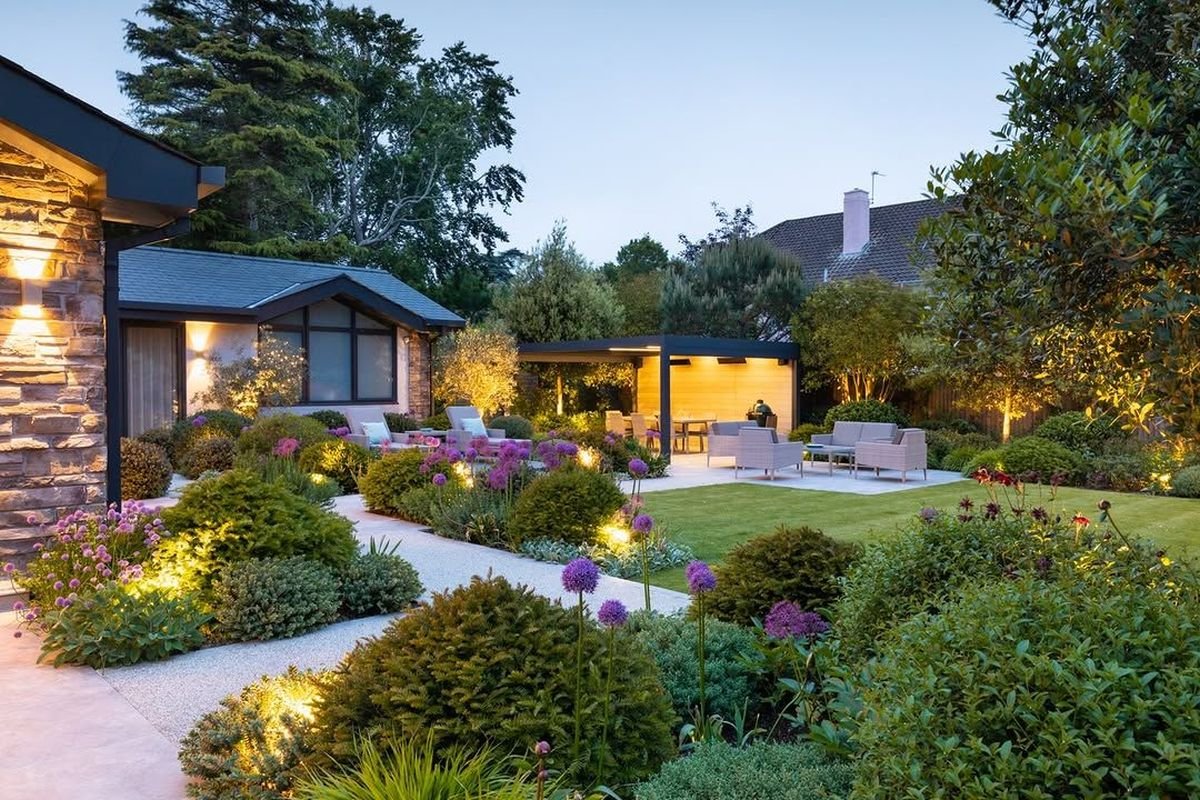
The yard uses lighting to connect different areas, from the house to the seating zone and planting beds. Small ground lights highlight shrubs and flowers, while wall lighting adds another layer near the structure. Space seems continuous from one zone to another.
What works here is balance. No single light dominates. Instead, the entire garden can be read as a composition. It replaces overhead lighting by spreading light across the ground and vertical surfaces at the same time.
Deck lounge with portable and ground lighting mix

This setup combines fixed lighting with movable pieces such as lanterns and floor fixtures. The deck is softly lit from below, while portable lights create a more comfortable seating environment. It offers flexibility without relying on string light overhead.
The planting around the deck is also softly lit, so the seating area doesn’t feel isolated. The result is a layered space where light defines both the platform and the surrounding greenery.
Perimeter LED lines that outline the entire layout

Here, lighting is used as a continuous line to define each edge. The lawn, planters and seating zones are all outlined, making the layout visible at a glance. It turns the yard structure into a major visual feature at night.
This approach works best in clean, geometric designs. Light replaces traditional fixtures and follows the architecture instead. It keeps the space organized and easy to read without adding visual clutter.
Raised deck with integrated step lighting

Lighting built into the steps and deck edges creates a clear transition between levels. Every step is visible, and the platform feels defined without the need for additional fixtures. It adds both function and structure to a space.
The glow also highlights the wood texture, giving the deck more presence at night. Combined with soft garden lighting nearby, it creates a balanced setup where the deck remains the focal point.
Garden path with focused plant spotlights

Instead of lighting the path directly, this design focuses on the plants along it. Small spotlights illuminate the flowers and foliage, creating a soft glow that spreads over the gravel. The route becomes visible without the main element.
This approach adds depth and keeps the garden from feeling flat. It also changes throughout the seasons as the plantings evolve, making the lighting seem dynamic rather than static.
Stepping stone path with minimal bollard lighting

Simple bollard lights placed at intervals guide movement across the lawn. The stepping stones catch enough light to remain visible, while the surrounding grass remains dark. It creates a calm, controlled environment.
This setup works well for large yards where too much lighting can feel overwhelming. It sets the direction without flooding the space with light, focusing on the path and the surrounding landscape.



