

Designing a bathroom with a double vanity should make routines easier, not overcrowded. These setups focus on spacing, layout, and material choices that give everyone a clear zone while keeping the overall design clean and harmonious.

Double vanity bathrooms in 2026 go beyond the basic “two sinks on one counter” approach. The focus shifts to separation, better flow and layouts that actually support two people using the space at the same time.
In this list, you’ll find double vanity ideas that handle spacing, storage, and lighting with more intent. Some divide the vanity into two separate units, others keep a shared surface but define each side by proportions and details. The result is a bathroom that feels balanced, practical and more comfortable to use every day.
Floating shelf vanity with open storage balance

This layout places both sinks on a single floating slab, but divides the base storage space into two distinct zones. Each user gets a defined section without adding bulk.
Open shelves below work well for a double vanity. Towels and everyday items remain accessible from both sides without overlap. It avoids the common problem of one person taking shared drawers.
Mirrors and lighting align perfectly with each sink, reinforcing that this is not one long station but two parallel stations.
Botanical wall meets soft mirror glow

Here, the double vanity splits into two separate sink platforms. The distance between them is important. It creates a natural buffer so that both users move independently.
Each mirror is attached directly to its sink, which avoids visual confusion. You always know which side is yours.
The result feels less like sharing and more like two personal vanities side by side.
Split minimal stations with hard edges

This is the most obvious example of a double vanity treated as two units. No shared counters, no overlap.
Each sink sits on its own platform, with its own mirror and lighting. That perfect separation eliminates friction during daily use.
It works best in tight bathrooms where personal space is more important than storage continuity.
A stairwell between two anchored vanities

This setup solves one of the biggest double vanity problems: shared storage.
Instead of pushing drawers under each sink, storage moves toward the center. Both users access it equally without entering each other’s side.
The two vanities remain clean and independent, while the middle acts as a neutral zone.
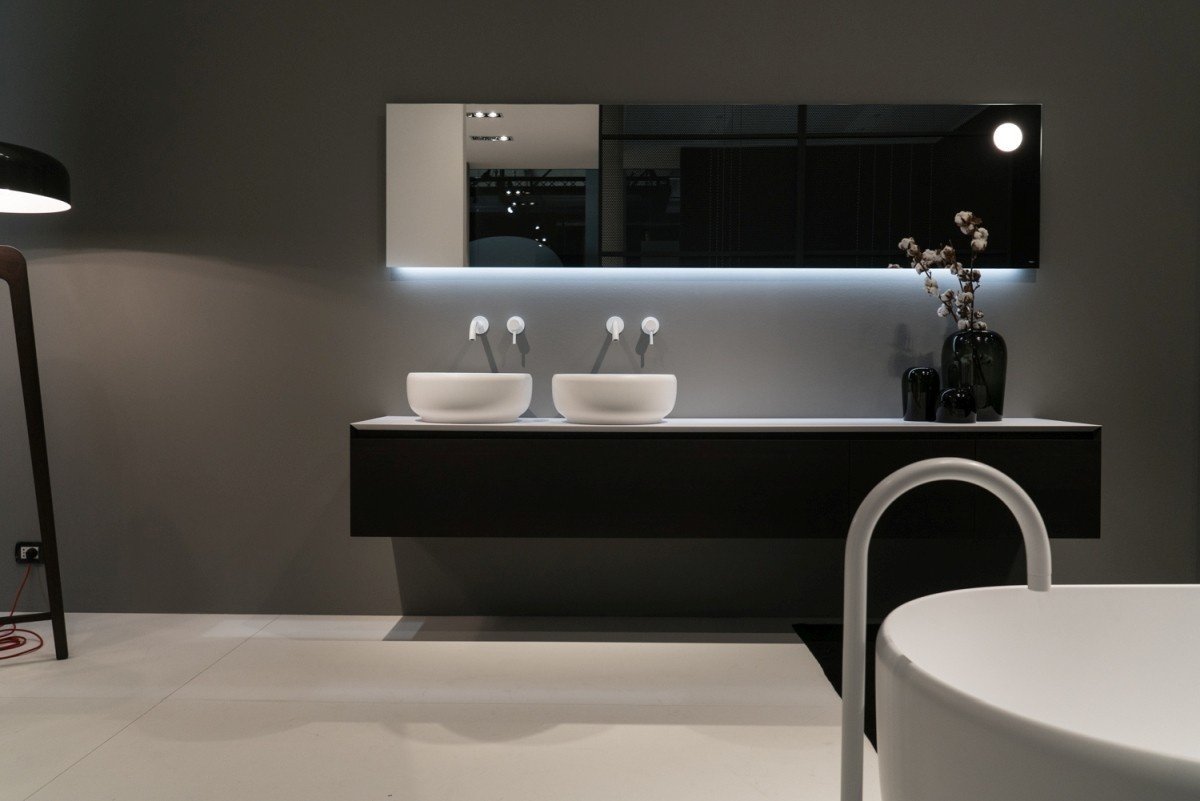
Continuous stone counter with soft light strip

Classic double sink layout, but controlled with more control.
Both basins sit on one long counter, yet a backlit mirror creates two visual sections. That light break gives each user a defined area without dividing the surface.
It’s a good solution when you want a seamless look but still need subtle separation.
A dark monolithic vanity with an industrial edge

This design keeps both sinks in one solid block, but the spacing works.
Each basin sits far enough apart to create two working areas. You avoid the crowded center that most double vanities suffer from.
It shows that partitioning is not just about dividing furniture, but about how space is used.
Patterned front with soft ambient lighting

This one focuses on symmetry. Two sinks, equally spaced, with matching lighting and mirror arrangement.
That balance is important in a double vanity. When both sides look the same, the space feels calm and easy to use.
The storage runs full width, but the visual rhythm sets each side apart.
Ultra minimal floating slab with hidden storage

One slab contains both sinks, but everything else disappears.
Storage goes from the bottom into the recessed volume, leaving the top completely clear. It reduces visual noise between two users.
Wall-mounted fixtures and a continuous mirror keep things simple, but distance still defines each position.
Bold color vanity with sculptural contrast

This design keeps the double vanity unified, but uses color and symmetry to define each side.
Two identical mirrors, two identical sinks, evenly spaced in bold cabinets. It creates clarity without physical separation.
Each user gets the same setup, which works well in shared bathrooms where balance is important.
Open frame vanity with natural element balance
Here, the double sink layout remains light and open.
The frame allows both users to access storage from either side, but the distance between the sinks keeps movement separate.
Adding a plant next to the vanity softens the shared setup and makes the area feel less functional, more relaxed.
Classic twin vanities with a furniture feel

This treats a double vanity as two separate pieces of furniture, not as one long unit. Each sink sits on its own cabinet, with the space in between creating a natural separation.
That distance is important. It eliminates the stress you have when two people share a counter. The movement seems independent.
Round mirrors above each sink reinforce the ensemble. You won’t question where one side ends and the other begins.
Sculptural double sink with full separation

Here, the double vanity does away with the idea of a shared surface entirely. Two freestanding basins stand apart, each serving as its own station.
No shared counter means no overlap. Each user gets full control over their space.
A backlight mirror floats behind the two, tying the connection together without forcing it. It’s minimal, but very intentional.
Floating double vanity with controlled symmetry

This layout goes back to the shared structure, but handles it with precision.
Two basins sit on a floating cabinet, spaced far enough apart to create two working zones. The long mirror above remains continuous, but the lighting line subtly divides the space.
It is a balanced approach. You keep the clean look of a single vanity, allowing each user room to function without interference.



