

Want a backyard that looks finished from the ground up instead of something that changes every season? These ideas replace exposed dirt and loose surfaces with hardscaping that defines how every part of the space is used.

In 2026, outdoor design is moving away from untreated land and undefined planted areas. Stone, gravel, wood and structured surfaces are used to control movement, reduce maintenance and give each zone a clear purpose.
From seating areas to paths and transitions, these examples show how replacing dirt with hardscaping can make a backyard feel more stable and usable.
Full patio surface instead of bare ground around seating

This setup completely eliminates exposed dirt and replaces it with large format pavers that carry the entire seating layout. Outdoor sofas, ottomans and tables sit on surfaces that feel level and defined, not something that shifts under use.
What makes the difference here is how the furniture aligns with the grid of the flooring. Instead of placing pieces on uneven ground, a hard surface turns the area into a proper outdoor room where movement and placement feel controlled.
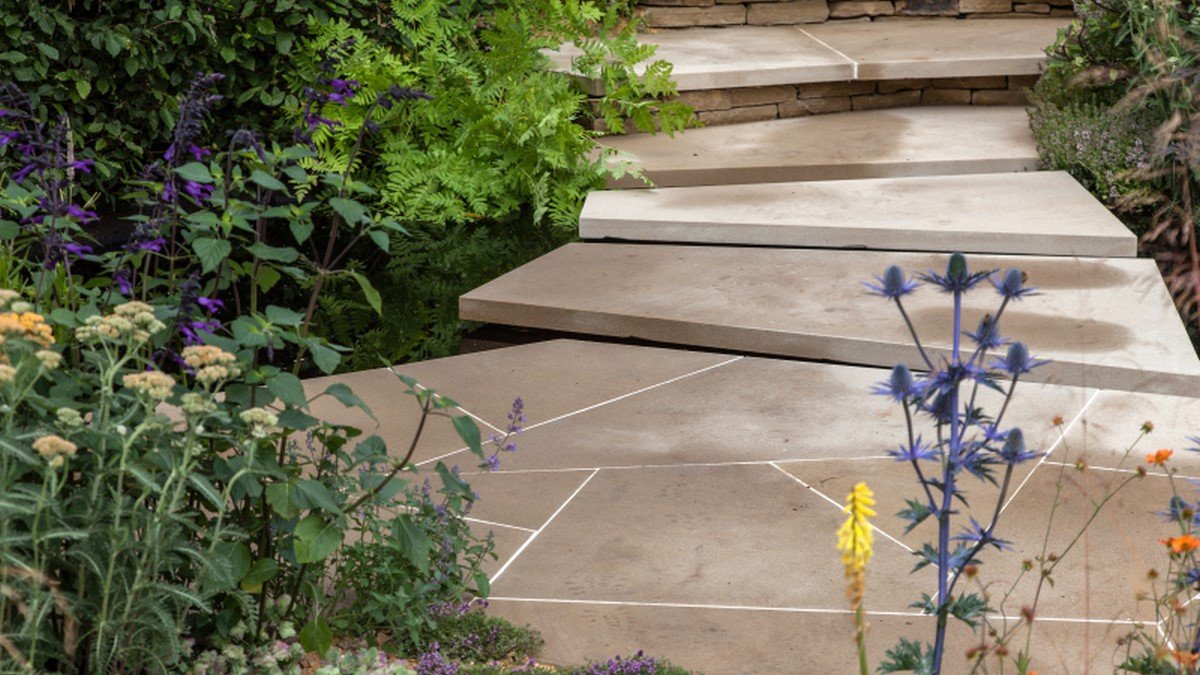
The stepped stone transition, which replaces the eroded garden slope

Instead of leaving the slope as compacted soil or mulch, this design uses wide stone steps to create a clear path upwards. The steps are integrated into the planting, but they hold the structure of the space.
Stone prevents erosion and defines how you move through the garden. It replaces a loose, shifting surface that feels purposeful and stable underfoot.
A curved built-in bench replaces loose outdoor seating on dirt

Instead of placing chairs directly on the soil or sand, these curved wooden benches create a permanent seating zone. The structure anchors the space and eliminates the need for movable furniture.
It also shapes how people gather. It replaces scattered seating with a continuous form that defines the edge of the area and makes it usable without constant rearranging.
Stepping stone paths replace worn grass and dirt paths

This path replaces what would normally be a worn strip of dirt across the lawn. Large stone slabs are spaced to guide movement with greenery between them.
It handles foot traffic without covering the entire surface. The result looks cleaner and more deliberate than a path that naturally builds over time.
A sculptural garden structure replacing an undefined open field

Rather than leaving the area open and undefined, this elevated timber structure introduces both form and function. It creates a focal point and draws movement to the garden.
The way around reinforces that direction. Together, they replace an empty patch of land with a space that invites use and interaction.
A framed pergola seating area instead of an open dirt zone

This design eliminates the loose ground beneath the seat and replaces it with a paved surface framed by a strong overhead structure. The pergola and flooring work together to define the space.
Instead of placing furniture on bare soil, everything sits within clear boundaries. It feels like a destination rather than a temporary setup.
Stone-framed water feature replacing open grass banks

Instead of letting the grass freely meet the water, this design uses stone slabs to frame the pond. The edges are controlled, and the transition between water and land is clearly defined.
This replaces the soft, uneven border that holds its shape. It also creates a path-like movement around the facility.
Gravel base instead of mud-prone ground around water features

This setup replaces soil with gravel around the fountain elements, which prevents mud and water from accumulating. The surface also remains consistent with constant moisture.
It also visually separates plantings from circulation areas. The gravel defines where you walk and where the greenery begins.
Structured walkways over water replacing open planting areas

Instead of leaving the planting bed completely continuous, this design introduces a hard path that cuts through the space. The black surface contrasts with the surrounding vegetation.
It clearly directs the movement. Without it, the area will feel like a continuous acreage with no defined path.
Compacted gravel paths replacing loose dirt walkways

A curved path like this often turns into uneven dirt over time. By replacing it with compacted gravel, the surface remains even and usable.
Edges contain content. It transforms a soft, shifting path into a stable circulation path.
A transition zone replaces mixed dirt and plant edges

This area between the steps and the planting is often left as bare soil. Here, gravel fills that transition and creates a clean separation between layers.
It prevents wear near the tread and keeps the edge intact. Space seems to end rather than escape.
A raised lawn path with stone inserts replaces the flat dirt layout

Instead of a flat dirt surface, this design raises the lawn slightly and adds stone slabs to guide movement. The path becomes part of the layout rather than something worn into it.
The contrast of elevation and material clearly defines circulation. It replaces an undefined ground plane that dictates how space is used.



