
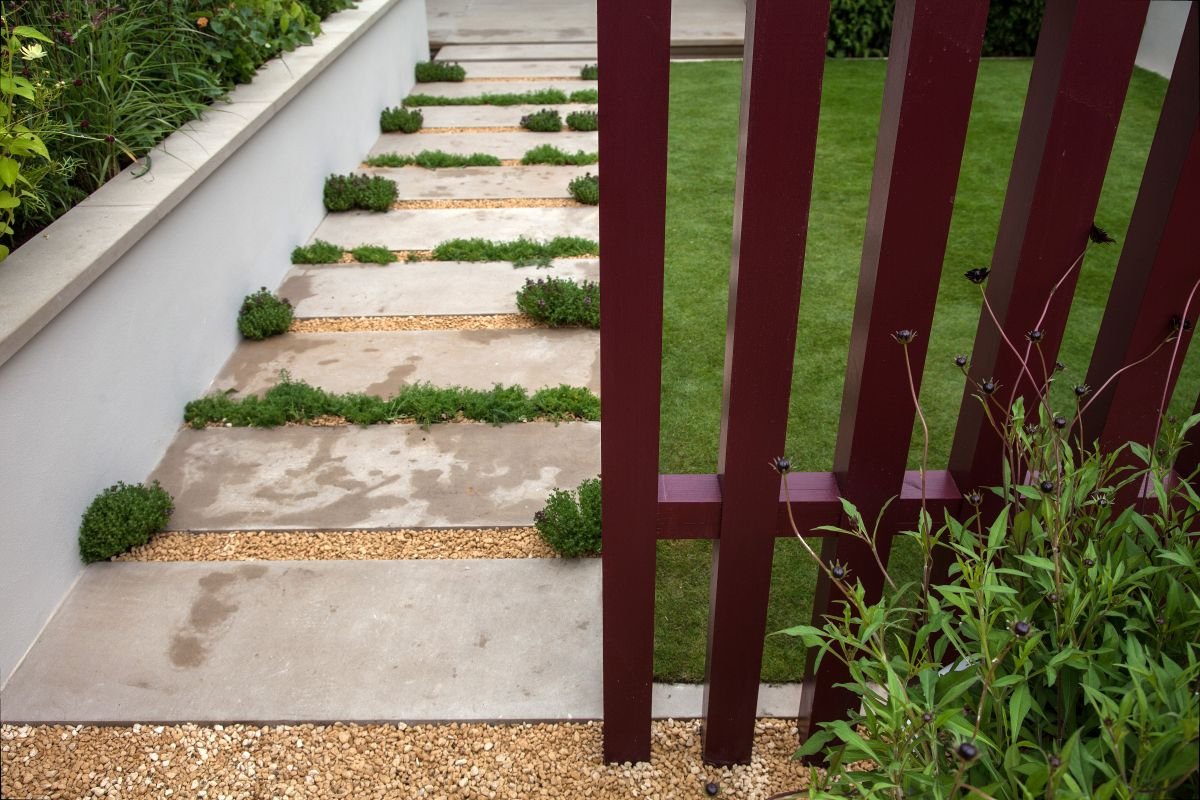

Want a backyard that looks designed rather than maintained? Most yards still follow the same pattern: wide grass zones shaped by what’s easy to mow. Path appears as an afterthought, not structure.

In 2026, movement leads to layout. Walkways define how the space works before planting. Stepping sequences, stone runs and gravel corridors replace the need for continuous mowing.
Each example below shows how a path controls rotation. The lawn is no longer pointing. The layout starts from where you walk.
Floating concrete pads set in gravel and succulents

Large circular concrete pads create a clear stepping rhythm through the arid landscape. Distance forces a steady pace and turns movement into sequence rather than shortcuts in the grass. Gravel fills the gaps, eliminating any need for trimming between elements.
Planting remains low and controlled, keeping the path readable from a distance. The walkway becomes the main structure, while the surrounding garden supports it without interfering with movement.
An irregular stone path through dense planting

Fragments of natural stone create broken paths that adapt to the terrain. The layout avoids straight lines, guiding movement through planting rather than cutting them. Each step changes direction, which slows the pace and adds depth.
Surrounding bushes and rocks line the edges of the path. There is no remaining lawn to maintain, only defined zones that separate circulation from planting.
A gently curving path through layered green dunes

The path meanders through rounded bushes and ornamental grasses, creating a continuous flow. The stepping stones sit low, almost blending into the ground, but still defining a clear path.
This layout eliminates any open grass corridors. The movement takes place within the plantation, not next to it, which shifts the focus from maintenance to experience.
Linear stone steps cutting through flower beds

Rectangular stones form a straight line through dense planting. The distance keeps every step in check, while the surrounding flowers soften the edges without obstructing the path.
There is no wide lawn strip between the beds. A walkway replaces that function, allowing the planting to expand while still keeping access clear.
Gravel garden path with wide stone inserts

Large flat stones sit within the gravel field, creating a stable walking surface. Gravel absorbs irregular edges and eliminates the need for precision cutting or edging.
This setup allows flexible layout changes. Stones can shift or expand over time without affecting the overall structure, which a grass path cannot handle.
A well-maintained garden path is framed by well-trimmed hedges

A central walkway leads through a formal garden, surrounded by a shaped hedge. The path defines the axis of the space, while the planting remains within clear boundaries.
No random movement across the lawn. Each route follows a path, which keeps the layout organized and reduces wear and tear on surrounding areas.
Compact entry path within fenced garden

Small stepping stones lead through a densely planted area towards the entrance. The path fits the scale of the space and avoids unnecessary width.
Grass will not do well here. The stepping layout keeps circulation clean without adding additional maintenance zones.
Modern slab path with pebble fill

Large square slabs sit on smooth pebble beds, creating a sharp contrast between the surfaces. Geometry sets the direction and keeps the layout simple.
Pebble gaps eliminate the need to trim edges. Even with heavy use, the road remains clean over time.
Layered gravel path with steel edging

The path uses compact gravel contained by metal edging to create clean lines. Level changes are not controlled by slopes, but by large steps.
This approach controls erosion and keeps the road stable. Grass paths on slopes often fail, but this structure holds its shape.
Natural garden path with informal stone placement

Round stones are placed in loose order by dense planting. The path seems embedded in the garden, not added later.
Movement remains intuitive even without strict alignment. The lack of grass eliminates the need for constant improvement or repair.
A curved stone path through flower beds

Flat stones follow a gentle curve to the edge of a planted lawn. The layout mixes open space with defined movement.
Instead of worn grass tracks, the stones absorb foot traffic and protect surrounding plantings. The path becomes part of the visual composition.
A pergola path that turns movement into a destination

Flat stone slabs pass through dense planting and lead directly to a covered pergola seating zone. The path is not secondary. It defines how the space is used and where it ends.
The layout eliminates the open lawn flow and replaces it with a directed sequence. Each step draws the eye forward. The destination is built into the path, then not added.
Framed entry path with inset geometry

A narrow path runs between raised stone ledges and clipped plantings. The surface mixes solid slabs with a patterned infill that adds rhythm without widening the footprint.
This setup replaces wide lawn access with controlled access. The edges remain fixed. Plants remain contained. The path becomes the planning line for the front yard.
Tree-lined paths with filtered light

Stone pavers sit in low ground cover while trees create a canopy above. The path remains narrow but seems level due to the change in height in the plantation.
Grass is no longer the main surface. The walkway defines the movement, and the planting creates depth around it. The result reads as a corridor rather than an open yard.
Natural stone path with embedded lighting

The rounded stones form an irregular path that follows the shape of the planting bed. Low lights sit close to the edge, marking the path without adding bulk.
This replaces straight lawn cuts with a softer layout. The path accommodates the planting rather than cutting through it. Movement follows the landscape, not the grid.
Linear slab paths on active lawns

Rectangular slabs are cut through the grass in a clean line toward the backyard structure. Spacing keeps the lawn visible but eliminates the need to walk on it.
The layout keeps the green surface but eliminates random foot traffic. The road absorbs movement. Lawns remain intact rather than wearing down over time.
Curved concrete path with planted edges

Large concrete shapes form a soft curve on the side of the house. Grasses and low plants fill the edges, blurring the line between hard and soft.
Curves replace hard cutting lines. Path defines the path, while planting controls the edge. Lawn no longer sets geometry.
Garden paths that cut through dense plantings

A narrow path leads into a deeply planted garden, surrounded by tiered flowers, shrubs and small trees. The path is visible but partially hidden by growth.
This eliminates the idea of an open lawn as a circulation space. Movement takes place within the planting zone. The path becomes part of the garden, not separate from it.
Side yard path with minimum width and gravel base

Flat stones sit on gravel in a tight side yard corridor. Plantings are kept low and controlled along both edges to keep paths clear.
This setup replaces unused lawn strips with a functional path. Each part of the space is defined. No area is left as remaining grass.
A straight path along the fence with structured planting

Stepping stones run parallel to the fence line, with raised planting on one side and an open lawn on the other. The direction remains constant from start to finish.
Paths eliminate diagonal shortcuts across grass. The movement follows a clear line. The rest of the yard remains intact and tidy.
Gravel path with irregular stone inserts

Large irregular slabs sit within a gravel base, surrounded by mixed plantings and small trees. Instead of going straight, the path varies slightly.
This breaks the idea of cutting strips into segments. Paths form the stream, while gravel and plantings occupy the rest of the surface. Lawns become optional.



