

Most TV walls follow a similar pattern: a screen in the middle, a unit below, and a few shelves around it. The layout is repeated, and the result seems to be expected.

These examples go far beyond that. The TV becomes part of a larger system where shelving, storage, lighting and wall treatments define the composition. Some extend across the wall, others break into sections or float off the surface, but each draws attention from the screen to the composition around it.
The difference comes from how the wall is built, not what is placed on it.
Backlit TV niche within full wall shelving

The TV sits within a recessed opening framed by shelves on all sides. A continuous light strip runs behind the niche, separating the screen from the structure and preventing it from blending into the unit.
The lower cabinet uses a fluted front, which adds texture without breaking the horizontal line. Open shelves carry books in controlled stacks, keeping the wall active without turning it into display clutter.
Green built-in library wall with integrated screen

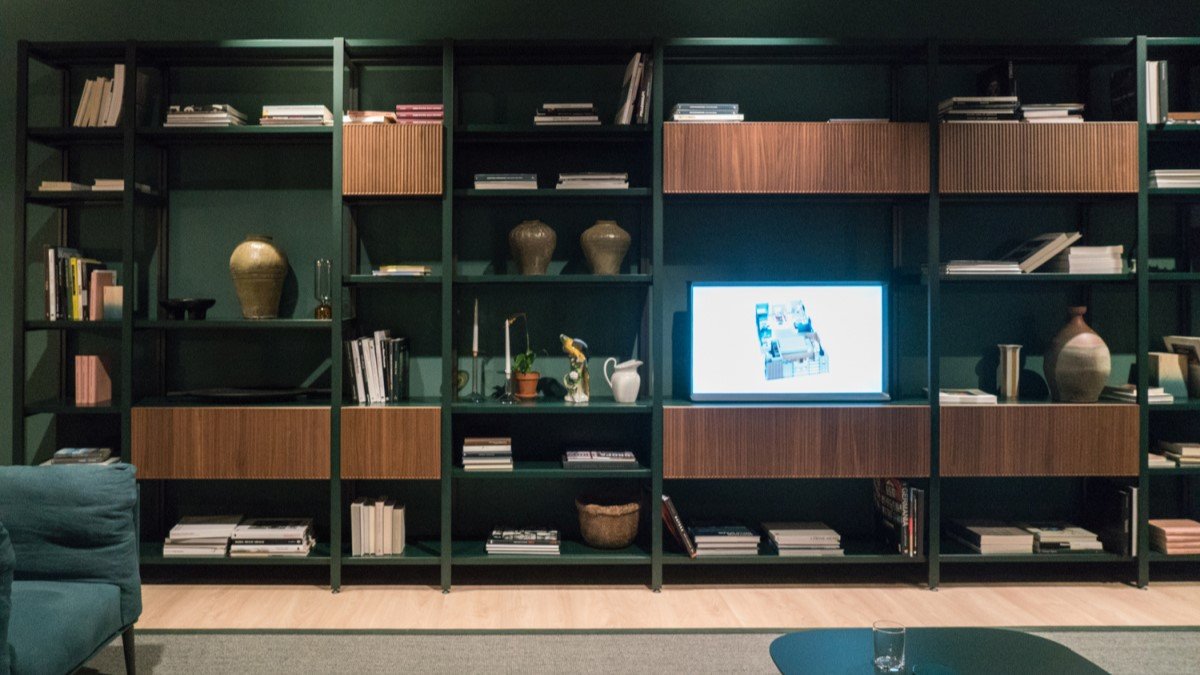
Shelves cover an entire wall, using deep green tones that turn the collection into a background surface. The TV is placed within a grid instead of being centered as a single object.
Wood inserts break up the repetition across the shelves, creating a rhythm across the wall. The result is a system where storage, display and media sit on the same level.
Floating desk and TV wall with linear storage

A wall connects a long floating desk with a compact TV zone. Upper shelves use short vertical sections, which create smaller sections without closing the system.
The entire structure is horizontal. The desk, storage and screen are arranged in a band, which keeps the wall quiet and avoids stacking too many layers.
A media wall framed by black brick and open shelving

The TV sits inside a low unit, while open shelves extend to the side. A black brick wall acts as a backdrop, giving weight to the system without increasing the size of the furniture.
Plants and vertical elements soften the rigid structure. The contrast between the solid wall and open storage keeps the layout from feeling flat.
Full wall storage with muted red cabinet system

The wall uses the same color on all the cabinets and shelves, which eliminates the contrast between the elements. The TV is centered in the composition but does not dominate it.
Different compartment sizes create variety without changing content. Balanced storage with alternating closed and open sections, displays.
Floating wood media unit with integrated lighting

The base unit floats above the floor, with an illuminated section behind glass that separates the storage from the structure. A thin shelf above the TV adds another horizontal layer.
Wall-mounted cabinets extend to the side, creating an offset composition rather than a centered one. Lighting defines each layer rather than relying on form alone.
Long linear media wall with open metal frame

A continuous lower unit runs on the wall, attached to a thin metal frame above. The TV sits in the center, while the frame extends beyond it, turning the wall into a giant system.
An open structure avoids visual weight. Objects remain minimal, allowing frame and proportion to define the layout.
Layered shelf and cabinet system with central screen

Shelves and cabinets stack in a controlled grid, with the TV positioned slightly above the base unit. This structure mixes closed volumes with open spans.
Wood tones and dark panels alternate, creating contrast without using color. Layout relies on alignment and spacing rather than decoration.
Mixed material media wall against light brick

The wall combines wood, matte panels and glass cabinets on a white brick background. The TV sits low, integrated into the base rather than mounted high.
Upper shelves remain shallow and minimal. The contrast between the textured wall and clean furniture defines the setup.
Minimal floating shelves with low media base

The TV sits on a low unit with wide gaps around it. Floating shelves above replace a full wall system, leaving large empty areas.
This approach leaves the wall exposed. Storage becomes selective, focusing on certain items rather than filling the entire surface.
Two-block storage system with side library unit

The composition is divided into two parts: a low TV base and a tall shelving unit on one side. This breaks the wall into zones rather than one continuous system.
Glossy cabinet fronts reflect light, while open shelves add depth. Asymmetry creates movement across the wall.
Dark media wall with horizontal light bands

A horizontal light strip runs above the TV, separating the upper storage from the base unit. The dark wall absorbs most of the light, making the bands stand out.
Shelves extend to both sides, but remain shallow. Focus remains on a central zone defined by light and alignment.
A concrete wall with floating shelves surrounds the screen

The TV sits on a low base, with floating shelves placed asymmetrically around it. A concrete wall provides structure without adding additional elements.
Shelves act as accents rather than storage. The composition relies on the negative space and the contrast between the rough wall and the clean lines.
Asymmetrical wall system with angled cabinets

The wall is broken by straight lines using an angular cabinet element. The TV sits low, anchored by a long base unit.
Open shelving and closed storage mix without following a strict grid. With shapes defining the layout instead of repetition, the result looks less rigid.
Complete wall grid with recessed TV niche and hidden storage block

The wall is divided into two distinct systems. To the left, an open grid of shelves runs from floor to ceiling, with integrated backlighting that turns books and objects into a continuous surface. The repetition of square sections eliminates the need for decoration as the structure fills the wall.
The TV sits within a recessed niche cut into this grid, pushed back so as not to interrupt the rhythm. To the right, a solid block of dark cabinets closes the composition. This contrast between open illuminated shelves and closed storage creates balance, while eliminating any unused wall space.



