
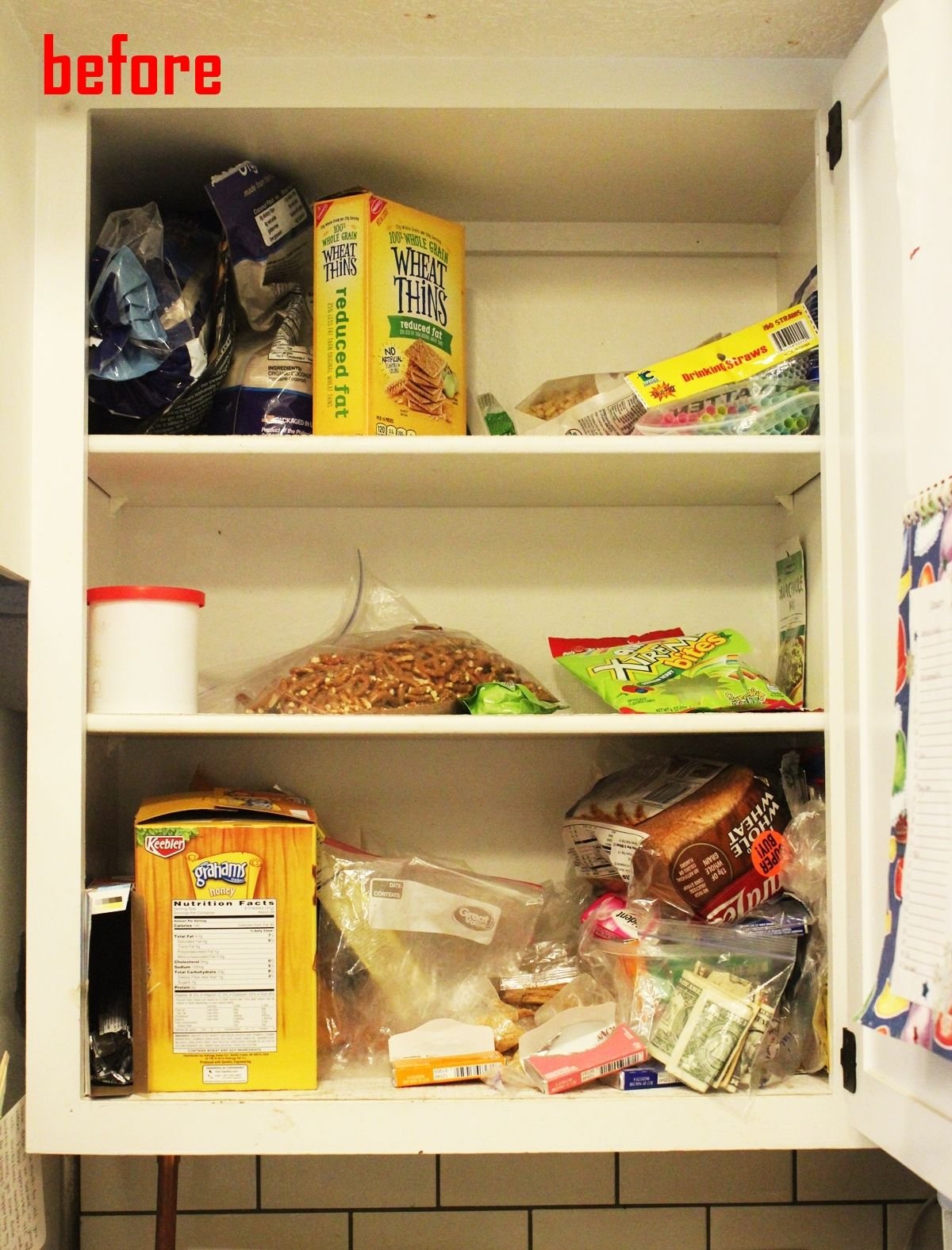

Even with enough space, kitchen cabinets turn into a mess. The problem is not how much it holds. The problem is how everything sits on a flat surface and changes every time something is moved.
Snacks are stacked on top of each other, small items slide backwards and anything that opens loses its place. The cabinet looks perfect, but most of the space is not used in a controlled manner.

Where the cabinet was failing
Everything is shared at the same level. There was no separation between categories and no second layer to use vertical space.
Once one item moved, the rest followed. Easy access to one item shifted the entire shelf, which meant the layout never stayed the same for more than a day.
This was not a storage problem. It was a structural problem.

Cut the cardboard to match the cabinet
The first change was forming the second layer.
I cut a piece of cardboard to match the exact depth of the cabinet. The size had to fit the shelf with no gaps so it wouldn’t slide or bend under the light weight.
This piece became the base for a raised shelf that allowed the upper space to be used without stacking items directly on top of each other.

Scoring and bending to form the base
Instead of adding separate parts, I drew straight lines in the cardboard where the base legs needed to be made.
The cardboard was then bent along the lines to create a vertical support under the main surface. This turns a flat sheet into a stable raised platform using the same material.
The shape is held because the folds create tension in the structure.

Strengthening the structure
Cardboard weakens at the fold point when weight is added.
I cut another strip along the matching fold line and placed it under the main panel. This added thickness at stress points and prevented the shape from flattening over time.
This step made the difference between a temporary insert and an object that retains its form during everyday use.
Locking everything in place
The fold structure needs to be stable.
Tape was used to secure the folds and attach the support strip to the main body so that it functions as one unit. Without this step, the structure will shift or open when objects are placed on it.
Once secured, the shelf can be lifted and moved without losing its shape.

Using shoe boxes to create zones
The shelf solved the vertical space, but the surface still needed control.
Old shoe boxes became containers for the series. Snacks, lunches and small packets were grouped instead of loose.
Each box acts as a movable section. Instead of reaching for a pile, the entire group can be pulled out, used and put back without affecting the rest of the cabinet.

Then what changed
The cabinet stopped resetting itself every time it was used.
Things stayed in place because they were no longer stacked loosely. A tall shelf allowed lighter items to sit higher, while bulkier items stayed lower without blocking access.
Everything became visible and reachable without moving other objects out of the way.

Why this works better than store organizers
Store organizers come in fixed sizes that rarely match the inside of the cabinet.
Cardboard adapts to the space. It can be cut to exact dimensions, adjusted if necessary and replaced without cost.
More importantly, this setup deals with how cabinets fail. It adds structure where there wasn’t any and creates zones that prevent items from spilling across the shelf.

What does this really improve?
The point was not to mess up. It lacked defined space. By adding a raised layer and dividing the surface into sections, the cabinet changed from a flat area to a controlled system. Items stopped competing for the same space, and the layout remained consistent without constantly rearranging.
This is not a permanent solution. It’s a low-cost setup made from recycled cardboard and old shoe boxes that most people already have. It works well for dry goods and lightweight items, but it doesn’t handle moisture and it doesn’t support heavy weights over time.
That’s why it works. It uses materials that can be cut, replaced or adjusted at any time without cost. When the layout needs to change, the system changes with it instead of changing.



