
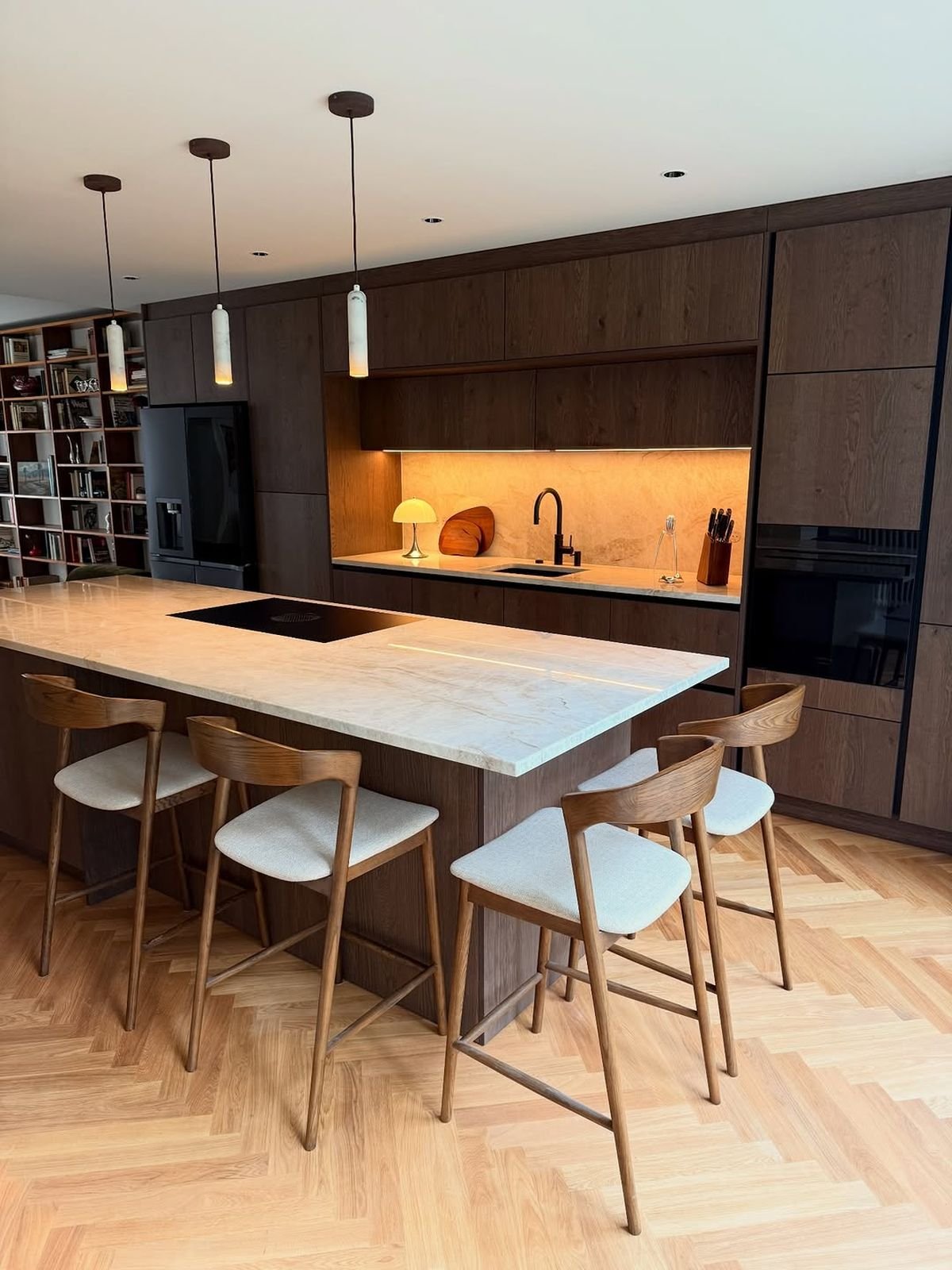

For decades, dishwashers have been placed under the countertop as if there was no alternative. It sits next to the sink, hidden in the base cabinetry, forcing you to bend over every time you load or unload it. Since this layout is everywhere, it seems logical. It is not.

A standard under-counter dishwasher opening is about 82-87 cm. is tall, which means that the bottom rack sits approximately 20-30 cm above the floor when pulled out. Every plate, every bowl, every glass needs a twist. Multiply that by years of daily use and repetition. The design is not dramatic in its flaws, but it is persistent in its tension.
An elevated dishwasher changes that whole equation.
Why a standard under-counter setup isn’t ideal
In a typical kitchen layout, the countertop height is between 90-92 cm. The dishwasher is installed directly below, which keeps the plumbing simple but locks the appliance into the least ergonomic zone of the room.
When open, the door protrudes about 60 cm into the walking path. extends to In a kitchen with only 90 cm of clearance between cabinets and island, movement becomes tight. If someone opens a drawer behind you, space is broken. If you’re unloading, you’re also blocking circulation.
This isn’t a workflow problem you notice on day one. It appears after a month of use.
The real problem isn’t the placement near the sink. The problem is the vertical position.
Elevated dishwasher: What changes in real terms
When the dishwasher is integrated with tall cabinetry, its base usually starts at about 40-60 cm from the finished floor, depending on the height of the user. It places the lower rack closer to waist level rather than shin level.
In practical terms:
- You unload without bending 20-30 degrees.
- The top rack sits near chest height, improving visibility.
- The appliance door no longer dominates floor circulation.
- Access becomes natural rather than repetitive stress.
The difference seems small on paper. In daily use, it is crucial.
This setup works best when the dishwasher is positioned within a special tall cabinet block that is 210-240 cm high, maintaining visual continuity. When integrated into a dark wood or matte finish facade, the device reads as an architectural mass, not a utility box.

Clearance that makes it functional
Elevating the dishwasher only works if the horizontal distance supports it.
In this kitchen, the distance between the island and the main cabinetry wall is 110 cm. That’s an extra 20 cm over the normal 90 cm standard. Completely changes the movement. It allows:
- Full drawer extension of 50-55 cm without collision.
- Opening the dishwasher door to a depth of 60 cm without blocking circulation.
- Two people to pass without friction.
If you’re planning to build a kitchen from scratch, aim for:
- Minimum functional clearance: 100 cm
- Comfortable daily use clearance: 105-120 cm
Anything below 95 cm starts to shrink once the devices are open.
Why most kitchens still keep it under the counter
The under-counter solution remains dominant because it simplifies plumbing runs and reduces cabinetry costs. It fits the pattern most contractors know. It avoids rethinking tall cabinet structures.
But not designed for kitchen installers. They are designed for someone who unloads the dishwasher 300 times per year.
Ergonomics should not be sacrificed for convenience.

Structural considerations before choosing this setup
Elevated dishwashers require advance planning. Drainage height, water supply routing and structural cabinet support must be considered prior to fabrication.
Important measurements to consider:
- Finished floor at the bottom of the appliance niche: 40-60 cm
- Standard dishwasher height: 81–87 cm
- Depth of long cabinet: 60 cm minimum
- Reinforced side panels for load distribution
This is not a last minute arrangement. It is a layout decision.
When properly integrated, the appliance becomes part of a vertical functional column that can also include an oven or pantry storage, creating a unified work area.
The real difference is not aesthetic
At first glance, an elevated dishwasher doesn’t scream innovation. It blends into the cabinetry. It does not advertise itself.
But good kitchen design isn’t about visible drama. It’s about eliminating daily friction.
- When you stop bending.
- When circulation remains open.
- While unloading feels natural.
That’s when you understand the difference between an installed kitchen and a planned kitchen.
If most kitchens still put the dishwasher under the countertop, that’s not proof that it’s true. It’s proof that habits are hard to challenge.
And this is a habit to challenge.



